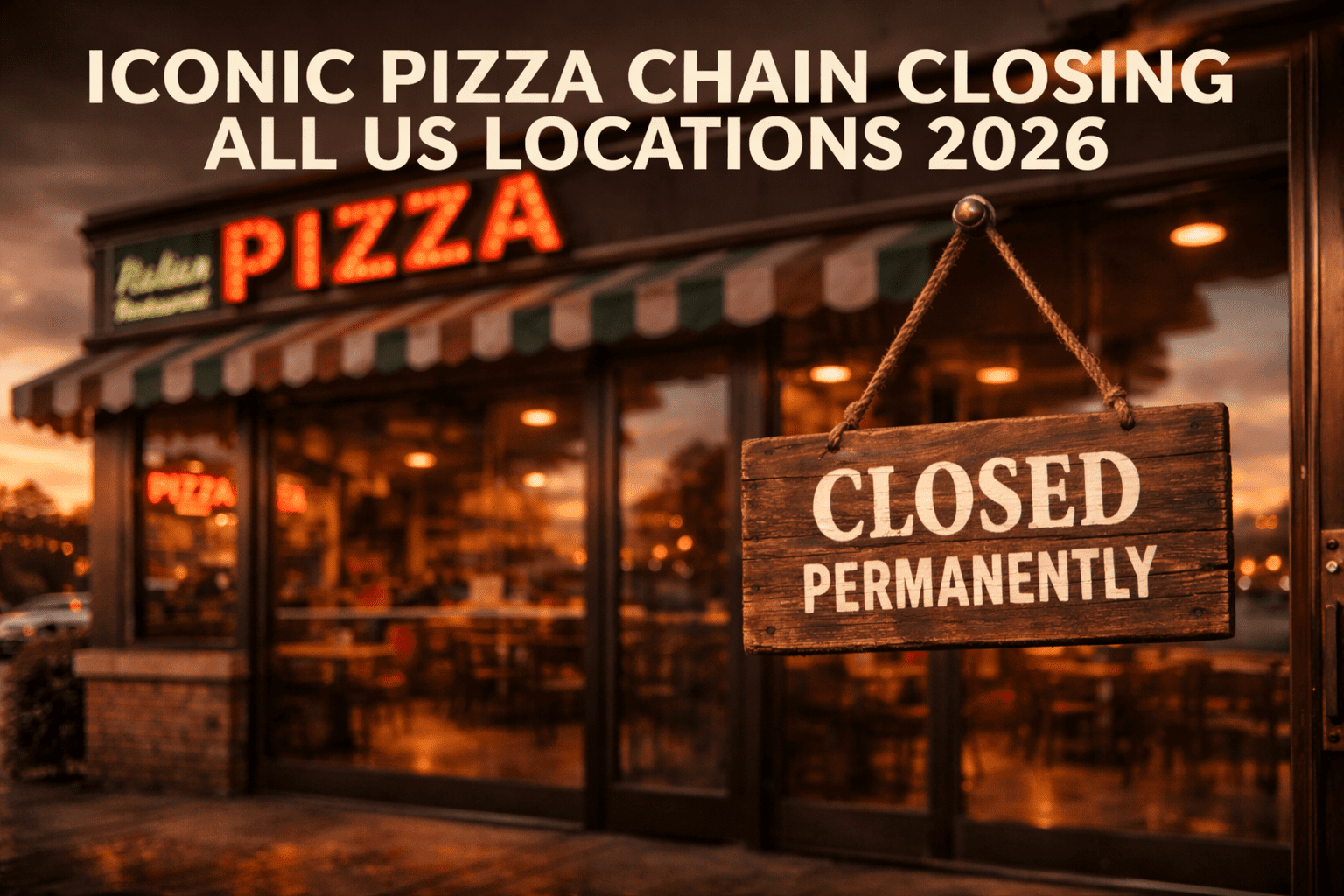
In a heart-wrenching announcement that marks the end of an era, we are witnessing a massive Pizza Chain Closing across the entire United States. It was a staple of Friday night lights, birthday parties, and the quintessential American suburban experience. But today, the ovens have gone cold.
In a move that has sent shockwaves through the fast-casual dining industry, this legendary brand has officially filed for Chapter 11 bankruptcy, announcing the immediate Pizza Chain Closing of all remaining locations. After five decades of serving pepperoni slices and memories, the 50-year legacy has come to an abrupt end. For millions of Americans, this isn’t just a business story; it’s the loss of a cultural landmark.
The History Behind the Iconic Pizza Chain Closing
Founded in the mid-1970s, this pizza giant began as a single storefront with a secret family recipe and a dream of bringing “the perfect slice” to every neighborhood. By the 1990s, it had expanded into a massive franchise network, boasting over 1,200 locations at its peak.
For decades, the brand thrived by staying consistent. It was the go-to for soccer team celebrations and office luncheons. However, the news of this Pizza Chain Closing proves that even the biggest giants can fall. As the calendar turned to 2026, the very consistency that built the brand became its Achilles’ heel.
Why This Sudden Pizza Chain Closing Happened in 2026?
Business analysts point to a “triple threat” that made survival impossible for the aging giant. The reasons behind this Pizza Chain Closing are a warning to the entire food industry:
1. The “Delivery App Trap”
While DoorDash, UberEats, and Grubhub provided a lifeline during the early 2020s, the commission fees—often reaching 30%—eroded profit margins. Unlike newer “ghost kitchen” models, this chain was burdened with massive overhead costs from maintaining large, sit-down restaurant spaces that were no longer being filled, leading eventually to this national Pizza Chain Closing.
2. Hyper-Inflation and Labor Costs in 2026
In 2025 and early 2026, the cost of high-quality flour, mozzarella cheese, and tomatoes reached record highs. Simultaneously, the push for higher minimum wages across the USA meant that the chain’s labor-intensive business model was no longer sustainable. “You can only raise the price of a large cheese pizza so much before the consumer walks away,” says industry experts discussing the Pizza Chain Closing.
3. The Rise of “Artisanal & Health-Conscious” Competition
Modern American consumers, particularly Gen Z and Millennials, have shifted their preferences toward sourdough crusts and organic toppings. The classic “thick crust and heavy grease” model struggled to compete with fast-growing, health-focused competitors, making this Pizza Chain Closing inevitable.
Read More: iPhone 18 Pro Max Rumors 2026 Top 10 Game-Changing Features
The Human Cost: 15,000 Jobs at Risk
The bankruptcy filing doesn’t just impact the corporate office; it hits the heart of local communities. This Pizza Chain Closing means an estimated 15,000 employees, from high schoolers working their first jobs to veteran managers with 20 years of service, are now facing an uncertain future.
The company’s CEO released a poignant statement: “We fought until the very last slice. But the economic landscape of 2026 is vastly different from the world we started in 50 years ago. We thank our loyal customers for five decades of memories.”
What Happens to Your Gift Cards and Rewards?
For customers holding onto loyalty points or unused gift cards, the news of the Pizza Chain Closing is grim. In most Chapter 11 filings of this scale, gift cards become nearly impossible to redeem once the physical doors are locked. Experts advise customers to check the official bankruptcy portal for “Proof of Claim” instructions, though recovery of funds is unlikely.
Is This the End of Pizza in America?
Hardly. While this giant has fallen, the US pizza industry remains a $46 billion market. However, the way we eat pizza is changing. Even after this Pizza Chain Closing, we are seeing a move toward:
-
Automation: Pizza robots that reduce labor costs.
-
Small Footprint Shops: Eliminating the “dining room” to save on rent.
-
Direct-to-Consumer Apps: Chains building their own delivery fleets.

The Legacy Lives On (in the Freezer Aisle?)
There is a silver lining for fans of the brand’s signature sauce. Rumors suggest that while we are seeing a total Pizza Chain Closing of restaurants, the company is in talks to sell its intellectual property (IP). This means we could see the “Famous Pizza Brand” name appearing in the frozen food section of Walmart or Kroger by late 2026.
The Domino Effect: How One Closure Impacts the Whole Industry
The news of this Pizza Chain Closing isn’t just a isolated event; it represents a “tectonic shift” in the American fast-food landscape. For years, the “Big Three” (Domino’s, Pizza Hut, and Papa John’s) dominated the market through sheer volume and massive advertising budgets. However, as this 50-year-old giant exits the stage, it leaves behind over 1,000 vacant storefronts across prime suburban real estate.
Real estate analysts predict that these locations will likely be snatched up by “Ghost Kitchens”—facilities that prepare food only for delivery—which carry much lower overhead costs. The era of the sprawling 3,000-square-foot pizza parlor with red-checkered tablecloths and arcade games is officially being replaced by high-tech, window-only pickup spots.
Consumer Psychology: Why Nostalgia Failed in 2026
Many wonder why a brand with such high “brand recognition” could fail. The answer lies in consumer psychology. In 2026, American diners are more “value-conscious” than ever. With the average cost of a family dinner climbing due to inflation, consumers are choosing between two extremes:
-
Ultra-Convenience: Cheap, fast, and automated (frozen pizza or high-speed kiosks).
-
Premium Experience: High-quality ingredients and “Instagrammable” artisanal crusts.
The chain that is now closing found itself stuck in the “boring middle”—neither cheap enough to be the value leader nor high-quality enough to be a premium choice. This “Death of the Middle Class Brand” is a trend seen across retail, from department stores to dining.
FAQ: Everything You Need to Know About the Pizza Chain Closing
1. Which specific pizza chain is closing all its locations?
While several regional chains have struggled, the recent filing involves an iconic national brand that has operated for over 50 years. (Note: Check the latest court filings for the specific brand name as the Chapter 11 process unfolds).
2. Can I still use my gift cards before the final Pizza Chain Closing?
Usually, once a company files for Chapter 11 and shuts its doors, gift cards become “unsecured debt.” This means they are often worth nothing. It is highly recommended to use any remaining balance immediately at any location that is still physically open.
3. Will the pizza be available in grocery stores?
Yes, there is a strong possibility. In many cases of a major Pizza Chain Closing, the company sells its “Intellectual Property” (recipes and brand name) to large food conglomerates like Nestlé or Kraft Heinz to be sold as frozen products in supermarkets like Walmart or Kroger.
4. How many employees are affected by this bankruptcy?
Current estimates suggest that over 15,000 workers across the USA are affected. This includes kitchen staff, delivery drivers, and corporate regional managers.
5. Is this part of a larger trend of restaurant closures in 2026?
Yes. Due to the “triple threat” of high labor costs, delivery app fees, and shifting consumer tastes, business experts predict that 2026 will see a 15% increase in bankruptcies for traditional “Big Box” restaurant chains compared to previous years.
6. What will happen to the empty restaurant buildings?
Most of these locations are leased. They are expected to be converted into medical clinics, “Ghost Kitchens,” or smaller, specialized fast-food outlets (like salad bars or coffee shops) that require less space and fewer employees.
Final Thoughts on the Pizza Chain Closing
The collapse of this 50-year-old institution serves as a wake-up call for the entire US restaurant industry. To survive in the late 2020s, a brand cannot rely on nostalgia alone. It must innovate, adapt its digital strategy, and, most importantly, provide value that justifies the rising cost of dining out.
The news of this Pizza Chain Closing will be remembered as a turning point in American fast-food history. Rest in peace to a true American original. You will be missed, but never forgotten.
1 thought on “Shocking: Iconic Pizza Chain Closing All US Locations After 50 Years”